
Cutting a neat chase in British brick and block sounds simple until dust fills the house, the discs stall, and the channel is too narrow for conduit. Go too light and you will struggle in hard masonry; go too heavy and overhead runs become exhausting. The trick is balancing raw power, dust control, and precise depth and width adjustment for clean, patch-ready grooves.
Top Recommendations at a Glance


Key Takeaways and Quick Advice
|
Metabo 604040590 MFE 40 Wall Chaser (220-240 V / 50-60 Hz)
|
PansyWind Wall Chaser with Dust Extractor Adapter 4000W 5 Blades
|
Makita SG1251J/2 240V 125mm Wall Chaser Supplied in A Makpac Case
|
|
|---|---|---|---|
|
|
|
|
|
| Build & Material | Robust metal gear housing with patented Marathon dust protection and enclosed push-cut guard | Heavy-duty steel shroud with vacuum adapter port and water-feed inlet, 5-disc spindle | Lightweight aluminium motor housing with SJS clutch, spring-loaded plunge guard and Makpac case |
| Power & Operation | 1900W, 220-240V, soft-start push-cut operation, holds speed well in concrete and brick | 4000W rated input, multi-blade drive, strong pace in plaster and block, can labour in very hard brick | 1400W 240V constant-speed electronics with SJS anti-jam, smooth start and low vibration |
| Capacity / Dimensions | 125mm discs, approx. 10-40mm depth, 9-35mm width adjustment for cables to conduit | 133mm-class 5-blade system, adjustable depth and width for narrow cable grooves to wide pipe chases | 125mm discs, approx. 6-30mm depth, 6-30mm width, ideal for electrical retrofits |
| Standout Feature | 1900W Marathon motor with patented dust protection and push-cut visibility | Five-disc adjustable cutting system with vacuum adapter and water feed | Constant-speed 1,400W drive with SJS anti-jam protection for smooth, near dust-free chasing |
| Best For | Trade and serious DIY use in concrete, brick and block where clean, accurate chases matter | Renovation work needing flexible widths for cables vs pipes on a tighter budget | Low-dust indoor electrical chasing with comfortable handling on vertical runs |
| Check Price on Amazon | Check Price on Amazon | Check Price on Amazon |
01
Powerful, Precise Chasing for Perfectly Clean Cable Channels
The MFE 40 sits at the top of the wall chaser category for good reason, pairing a powerful 1900W Marathon motor with thoughtful dust management and control. Its robust die-cast aluminium hood with rubber rollers glides steadily along marked lines, while push-cut geometry keeps visibility clear for accurate cable and pipe channels up to 40mm deep. Owners consistently highlight how easily depth and width adjust with spacers, making setup logical even for first-time users. Ergonomics are a clear strength, with balanced handling and well-placed grips that reduce fatigue during longer runs in brick and concrete. Safety touches like soft start, restart protection and automatic clutch add confidence when discs bite unexpectedly. Paired with a capable extractor, dust control is reported as excellent. The main trade-offs are weight, lack of included extraction hose, and reliance on quality diamond discs for best results.
- Powerful 1900W motor cuts confidently through concrete and brick
- Precise, easily adjustable depth and width for neat channels with less patching
- Excellent dust control when paired with a capable extractor
- Solid build with die-cast housing and effective safety features
- Comfortable push-cut handling with good line visibility
- Heavier than budget rivals, can fatigue on overhead work
- No dust hose included, extractor and quality discs essential for best performance
- Isolated durability concern noted among otherwise highly positive feedback
02
Five-Blade Muscle For Fast, Adjustable Chases In Brick And Concrete
Positioned as a workhorse for trades and renovators, this PansyWind chaser leans on sheer cutting width rather than finesse. The metal housing with anti-rust coating suggests site-ready durability, while the slim rear handle plus auxiliary front grip helps manage its 7.5kg heft on longer runs. Market specs point to a high-output motor driving up to five 120mm discs at 6000rpm, with adjustable width and depth to around 35mm for wiring and pipe channels. Verified owner sentiment is broadly positive about speed in plaster, block and softer brick, with many noting versatility when running multiple blades. The integrated dust port and included water pump aim to tame airborne fines, though feedback on extraction efficiency is mixed. One report of struggling in dense red brick suggests blade performance and technique matter. Best viewed as a powerful, adaptable slotter where dust management is planned separately.
- Strong cutting pace in plaster, block and softer masonry per verified owners
- Five-blade setup allows flexible groove widths for cables vs pipes
- Adjustable depth and width suits varied retrofit and renovation tasks
- Complete kit with case, spare blades, water pump and vacuum adapter
- Dust extraction performance is inconsistent and still leaves significant cleanup
- Heavy to handle and can feel strained with all blades engaged in very hard brick
03
Powerful, low-dust chasing that glides through masonry with pro control
The Makita SG1251J/2 is built around a 1400W motor driving 125mm discs to 10,000rpm, with constant speed control, soft start, electronic current limiter and Super Joint System for smoother, safer cutting. Owners consistently highlight its ability to sink clean, parallel chases from 6-30mm wide and up to 30mm deep in brick, block and stone, with the tool feeding steadily under its own weight when technique is right. At 4.5kg with soft-grip handles and double insulation, it balances power with manageable ergonomics for vertical wall work, and dust extraction is highly effective when paired with a capable vacuum. Long-term sentiment is strong, including repeat buyers keeping older units as spares. Trade-offs include mandatory dust extraction for best results, occasional need to adapt the extraction collar fit, and Makpac case quality that divides opinion. Overall, verified feedback positions it as a dependable, low-mess upgrade over angle-grinder methods for electricians and renovation specialists.
- Strong, constant power that holds speed well under load in masonry
- Very low dust levels when used with proper extraction and correct technique
- Lightweight yet solid feel with comfortable control on vertical runs
- Precise, easily adjustable chase width and depth for tidy installations
- Needs a capable dust extractor to achieve its best low-dust performance
- Extraction collar fit and Makpac case quality draw mixed owner feedback
 04
Twin-pack cordless power that cuts clean 30mm chases without a cord
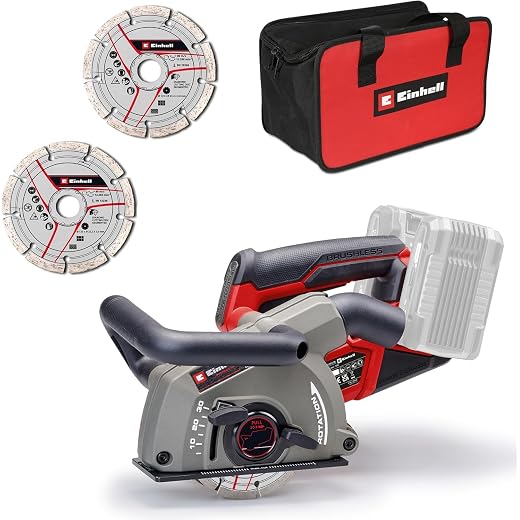
The Einhell Professional TP-MA 36/30 Li BL brings corded-like muscle to a Twin-Pack cordless platform, running on two 18V Power X-Change batteries to drive twin 125mm diamond discs. Market research shows its PurePOWER brushless motor is a consistent highlight, praised for smooth soft-start, sustained cutting in brick, block and concrete, and long service life backed by extended motor coverage after registration. Owners point to stepless 30mm depth and width adjustment, guide roller and auxiliary handle for controlled pull cuts, plus spindle lock for fast disc changes. The integrated dust extraction port helps keep grooves and work areas cleaner when paired with a vacuum. At just over four kilos before batteries, it feels substantial but manageable for short wall and floor runs. Verified sentiment skews strongly positive for build quality and ease of use, with the main caveats being battery appetite on deep cuts and bare-tool supply requiring existing PXC investment.
- Cordless freedom with confident cutting in plaster, brick, block and concrete
- Smooth controlled handling via guide roller, auxiliary handle and soft start
- Highly flexible stepless depth and width adjustment for different installs
- Low-maintenance brushless motor with easy disc changes and dust port
- Supplied bare without batteries or charger, so newcomers face extra investment
- High power draw on long deep cuts means large capacity packs are essential
- 30mm maximum depth and width may feel limiting for larger commercial work
 05
Corded-like chasing power in concrete with true 54V cordless freedom
The DeWalt DCG200NT brings true corded-class capability to a 54V FlexVolt cordless platform, built around a brushless motor tuned for sustained cutting in concrete, stone and masonry. Verified owners consistently highlight its ability to drive twin 125mm discs through tough material with clean, parallel grooves and reliable depth control for electrical and plumbing chases. The enclosed guard pairs well with an external extractor to keep the work area noticeably cleaner, while tool-free-style adjustment and straightforward disc changes keep workflow efficient on site. At 3.7kg plus battery, it feels substantial and planted, which aids stability but demands ear protection and steady handling during longer runs. Supplied as a bare unit in TSTAK-compatible storage, it makes most sense for trades already invested in the FlexVolt system. Minor owner notes around side dust escape and handle angle do not detract from its reputation as a powerful, site-ready chaser.
- Strong, consistent cutting performance in concrete and masonry per verified owners
- Clean and precise twin-disc grooves with adjustable depth
- Effective dust control when connected to a suitable extractor
- Robust ergonomic build with convenient TSTAK-compatible transport case
- Supplied as bare unit, so battery and charger require separate investment
- Feels heavy and loud during extended cuts, especially with large capacity packs
 06
Brute-force multi-blade chaser built to power through concrete, brick and stone.
The VICSEC wall chaser is built around sheer cutting capacity rather than finesse. Its magnesium-alloy head houses a high-output 4200W motor spinning up to 6500 RPM, driving up to seven 133mm blades for slots up to 42mm wide and 41mm deep in concrete, brick, marble and granite. Verified owners consistently highlight its ability to handle demanding jobs like slab channels and long driveway cuts that would stall smaller machines. Ergonomics are workmanlike: dual rotating handles, lock-on switch and infrared guide aid positioning, while the movable guard helps reach corners. At 6.5kg it is undeniably hefty and demands a firm stance plus a straight-edge guide for best accuracy. Dust is managed via included water pump and vacuum adapter rather than full extraction. Overall sentiment skews positive for power and completeness of the kit, with the trade-off being weight, 110V site-power requirement and a steeper learning curve for precise work.
- Strong cutting performance in concrete, slab and hard brick reported by owners
- Generous 5-blade starter kit plus pump, hose and carry case included
- Adjustable width and depth setup suits electrical and plumbing chases
- Infrared guide and 360-degree movable cover aid accuracy in corners
- Heavy 6.5kg build requires significant force and tires arms on long runs
- 110V power requirement limits it to site supply or transformer use and can trip breakers under load
Buyer Questions and Expert Answers
What depth and width do I need for UK electrical and plumbing chases?
For a single 2.5mm twin-and-earth cable in oval conduit, aim for around 20-25mm wide and 25mm deep. For 20mm round conduit or central heating pipes, you will typically need 30-40mm wide and 30-40mm deep. Choose a chaser with tool-free depth and width adjustment so you can cut once to the right size, leaving just enough cover for plaster (usually 10mm+ over conduit) without weakening the wall.
Do I need a dust extractor, or can I just cut dry?
You need a capable extractor for indoor work. Wall chasers generate extreme fine silica dust from brick, block and concrete. Use an M-class extractor with a tight-fitting hose, keep the shroud flat to the wall, and cut in a steady push motion. Shake or pulse the filter regularly. For very dusty concrete, a water-feed option or pre-scoring plus extractor gives the cleanest result and protects motor and lungs.
Will these wall chasers cut concrete, engineering brick and block?
Yes, with correct diamond discs and technique, but hardness matters. Lightweight block and plaster chase quickly with any of the three. Medium brick and concrete need constant speed and patience — let the discs do the work, avoid forcing, and clear the core with an SDS chisel. Very hard engineering brick or reinforced concrete will be slower and wear discs faster; take shallow passes and allow cool-down time.
Is a 2-disc or 5-blade setup better?
A standard 2-disc setup with spacers is lighter, easier to control, and ideal for neat electrical chases — you knock out the centre. A 5-blade system removes more material in one pass and can cut wider pipe chases faster, but it is heavier, draws more current, and strains harder in dense brick. If you mainly chase cables, 2-disc precision wins; if you regularly chase wide runs for pipes, multi-blade flexibility helps.
What safety and UK site essentials should I check before buying?
Check voltage: 240V is standard for home DIY, while many UK sites require 110V — these picks are 220-240V models for home and workshop use. Always use eye, ear, FFP3 dust mask and glove protection, plus RCD protection. Confirm disc size (125mm is widely stocked in the UK), arbor size, and that spacers and flanges are included. Never use without the guard, never grind sideways with chase discs, and check for hidden cables and pipes with a detector first.
The Bottom Line
- 🏆 Top Overall Choice: Metabo 604040590 MFE 40 Wall Chaser (220-240 V / 50-60 Hz) — best blend of 1900W power, accurate adjustment and dust-protected durability for masonry
- 💰 Best Value: PansyWind Wall Chaser with Dust Extractor Adapter 4000W 5 Blades — most flexible multi-width cutting for retrofit cable and pipe work
- ⭐ Premium Pick: Makita SG1251J/2 240V 125mm Wall Chaser Supplied in A Makpac Case — smoothest, lowest-dust choice for controlled indoor electrical chasing
For most UK buyers chasing brick, block and concrete, precision plus dust control matters more than headline wattage. Choose the Metabo for confident, trade-grade cutting and the cleanest adjustable grooves, the PansyWind if you want maximum width flexibility for cables and pipes on renovation work, and the Makita if you prioritise smooth constant power, low dust and comfortable handling for indoor electrical runs. Pair any of them with a strong extractor and quality diamond discs, set depth once, and you will get straight chases that are faster to patch and redecorate.
Leave a Reply