
Flat battery on a frosty morning or after weeks parked at the airport? For UK drivers the real dilemma is size versus starting power. Go too compact and you risk struggling with larger diesels in winter, go too powerful and you are left with a heavy brick that lives in the boot and is slow to recharge.
Top Recommendations at a Glance


Key Takeaways and Quick Advice
|
NOCO Boost X GBX45: 1250A UltraSafe Jump Starter Power Pack – 12V Car
|
NOCO Boost GB70: 2000A UltraSafe Jump Starter Power Pack – 12V Car Battery
|
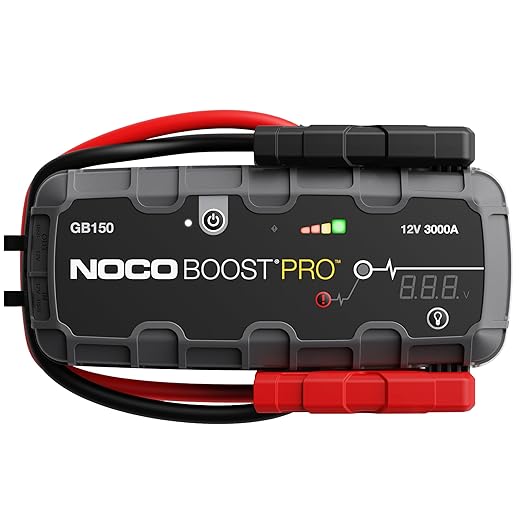
NOCO Boost GB150: 3000A UltraSafe Jump Starter Power Pack – 12V Car Battery
|
|
|---|---|---|---|
|
|
|
|
|
| Build & Material | Rugged yet lightweight compact housing with solid clamps and clear indicators, soft storage bag only | Solid IP65-rated housing with quality clamps for durability, heavier and bulkier feel | Large heavy-duty housing built for workshop use, spark-proof design, no hard case in the box |
| Power & Operation | 12V, 1250A peak with UltraSafe 2.0 protection, drama-free starts for petrol and mid-size diesel | 12V, 2000A peak with UltraSafe spark-proof system, strong starts even on fully flat batteries | 12V, 3000A peak with UltraSafe system, rated for up to 9.0L petrol and 7.0L diesel engines |
| Capacity / Dimensions | Most compact and portable of the three, ideal for glovebox or small emergency kit | Mid-size footprint at approx. 2 kg, balances power with boot-friendly portability | Largest footprint at approx. 3.4 kg, boot storage rather than truly portable, slower USB recharge |
| Standout Feature | UltraSafe 2.0 + 60W USB-C power bank versatility for phones and devices | 2000A spark-proof starting tuned for fully flat large petrol and diesel batteries | Voltmeter display, power-bank ports and bright multi-mode LED for roadside diagnostics |
| Best For | Everyday drivers with cars, SUVs, vans and mid-size diesels wanting compact readiness | Owners of larger petrol and diesel cars needing maximum value and forgiving safety | High-mileage, commercial, van and agricultural users needing massive cranking reserve |
| Check Price on Amazon | Check Price on Amazon | Check Price on Amazon |
01
Pocket-sized 1250A powerhouse that brings dead batteries back to life in seconds
Positioned at the top of the jump starter category, the NOCO Boost X GBX45 blends serious cranking capability with everyday portability. Market research and verified owner sentiment consistently highlight its rugged lithium-ion construction, compact footprint that stows easily in a boot or glovebox, and confident clamp feel with spark-proof and reverse-polarity safeguards. In real-world use, owners report reliable starts on family cars, vans, campers and mid-size diesels, often after months in storage with minimal self-discharge. Ergonomics earn praise for clear status indicators, detachable leads and simple start sequence, while USB-C Power Delivery adds genuine utility as a power bank for phones, tablets and laptops. The integrated LED with SOS modes proves useful for night breakdowns. Balanced against this are a premium positioning versus budget rivals, no hard shell in the box and no wall charger included, plus limits for larger commercial engines. Overall satisfaction remains very high across a large owner base.
- Strong, drama-free starting performance on cars, SUVs, vans and mid-size diesels
- Excellent charge retention in storage, ready after months in the boot
- Rugged yet lightweight and compact design with solid clamps and clear indicators
- Versatile 60W USB-C power bank plus bright LED with emergency modes
- Premium-tier positioning compared with budget alternatives
- Soft storage bag only with no hard case or wall charger included
02
Serious 2000A starting muscle with foolproof safety for big petrol and diesel engines
The GB70 pairs high-discharge lithium power with a rugged IP65-rated housing and rubberized over-molding that verified owners consistently describe as solid and confidence inspiring. Its compact rectangular form and roughly five pound heft strike a practical balance between portability for glovebox or emergency kit storage and the mass needed for serious starting duty up to large petrol and diesel engines. High-conductivity clamps, clear polarity indication and spark-proof reverse protection make hookup forgiving for novices while satisfying professionals who use it daily. The integrated power bank plus 12V output and bright multi-mode LED add real roadside versatility for phones, accessories and night repairs. Owners highlight repeated starts on a single charge and reliable firing of fully depleted batteries when manual override is used correctly. Tradeoffs include noticeable weight versus smaller boosters, shorter clamp cables that can feel fiddly in tight bays, and gradual self-discharge during long idle storage that rewards topping up.
- Strong 2000A starting performance for large petrol and diesel engines, including fully flat batteries
- UltraSafe spark-proof and reverse-polarity system makes connections forgiving for beginners
- Solid IP65-rated build with quality clamps that earns high praise for durability
- Versatile roadside tool with power bank, 12V output and bright multi-mode LED
- Noticeably heavier and bulkier than compact boosters, less ideal for minimalist kits
- Clamp cables run short and can feel fiddly in tight or awkward engine bays
- Gradual self-discharge in storage means it needs periodic top-ups for emergency readiness
03
Heavy-duty 3000A muscle for big petrol, diesel, trucks and farm kit
Based on market research and verified owner sentiment across more than twelve thousand ratings, the GB150 stands out as the heavyweight option for those who regularly deal with big engines. Owners repeatedly report confident starts on large V8s, vans, tractors and even commercial diesels, often with plenty of reserve for multiple attempts. Build perception is strong, with a dense 3.4kg chassis, rubberized armor, water and dust resistance, and solid clamps that transfer energy effectively. Ergonomics reflect its power, it is closer to tissue-box size than pocket size, so it suits a boot, workshop or farm shed rather than a glovebox. Everyday utility is boosted by the clear voltmeter display, power-bank function and multi-mode LED. Satisfaction is tempered by slow recharging over standard USB unless you add the faster mains adapter, the thin storage pouch, and occasional failures linked to incorrect override use, which underlines the need to follow instructions carefully.
- Massive cranking capability for large petrol, diesel, commercial and agricultural engines
- Thoughtful safety system with spark-proof design and reverse-polarity protection
- Useful voltmeter, power-bank ports and bright multi-mode LED for roadside work
- Rugged IP65 build with durable clamps that owners describe as confidence inspiring
- Large and heavy footprint makes it boot storage rather than truly portable
- Slow to recharge via standard USB and lacks dedicated fast charger and hard case in the box
 04
Starts 10L diesels and inflates truck tyres fast — one rugged box does it all
The MV24Air stands out in the jump starter category by merging serious cranking power with a genuinely capable inflator, rather than treating air as an afterthought. With 4000A peak output rated for up to 10L petrol and diesel engines, verified owners regularly report instant starts on large diesels and fully flat batteries, including winter failures where breakdown help would mean long waits. The 160 PSI compressor with 45 L/min airflow, real-time display and auto-stop earns equal praise for fast, set-and-forget top-ups on cars, SUVs and pickups, plus bikes and balls via included adapters. Build centres on a rugged IP64-rated housing with heat vents, strong-grip smart clamps with reverse-polarity protection, bright 400-lumen torch with SOS, and 65W USB-C plus USB-A/DC for power-bank use. Ergonomics benefit from compact footprint, EVA case and simple preset controls. Trade-offs are heft at over 5 lb and need for a high-wattage charger for fastest refills.
- Confident starts on large diesels and fully discharged batteries
- Fast, accurate inflator with auto-stop that owners use weekly for maintenance
- Thoughtful safety and usability: reverse-polarity protection, clear display, simple presets
- Rugged IP64 build with EVA case, strong clamps and bright SOS torch for night breakdowns
- Heavier and bulkier than jump-only packs at over 5 lb, better for boot than glovebox
- Needs a 65W or higher PD wall charger for fastest recharging, which is not included in the box
- Valve adapters and custom pressure mode have a small learning curve for first-time users
 05
Serious 2000A starting power for large petrol and diesel engines with laptop-ready backup charging
Positioned at the top of Ring’s UltraBoost range, this 2000A unit is aimed at drivers of larger petrol and diesel vehicles who want reserve starting power without roadside assistance. Market details describe a compact black and blue housing supplied with a storage pouch, ergonomic smart clamps with extended cables for awkward battery bays, a LED charge display and simple single-button control for power and lighting. Verified owner sentiment leans positive, with multiple reports of successful starts on 3.0-litre diesels, tractors and flat car batteries, plus praise for fast recharging, effective power-bank performance for phones and even laptops via high-wattage USB-C, and a useful torch with steady and emergency modes. Balanced against that is a critical note around a modern vehicle with complex electronics that would not start until fault codes were cleared, a reminder that no booster overrides underlying electrical faults. Some owners also flag premium positioning and 1.2kg heft.
- Strong real-world starts reported on large diesels, tractors and flat batteries
- High-output USB-C power bank supports laptops and fast phone charging
- Long smart clamp cables improve access to awkward battery locations
- Integrated safety protections with audible and visual alerts plus LED torch with SOS mode
- Modern vehicles with electronic faults may still need code reset before starting, per critical owner feedback
- Heavier and more premium-positioned than small commuter boosters, with limited long-term review history
 06
Serious 3000A muscle that wakes big petrols, diesels and long-dead batteries in seconds
Positioned as a heavy-duty solution for large displacement vehicles, the JS3000 pairs a 3000A peak output with a 24000mAh lithium-ion reserve rated for up to 9.0L petrol and 7.0L diesel engines. Market research and verified owner sentiment point to dependable real-world starts on deeply discharged batteries, including large V8s, V12s and long-stored diesels, with ample reserve for repeated attempts. Build centres on a fire-resistant IP54 housing with heavy-gauge cabling, 100 percent copper clamps and weather-resistant connectors, plus a practical extendable hook and tilt stand for roadside or campsite use. Day to day it doubles as a power bank with dual USB QC outputs, bi-directional Type-C PD45W and DC output, alongside a bright 400-lumen light with SOS. Owners praise the tidy EVA case and straightforward boost operation, though some note slower full recharges and a need for firm clamp contact for best results, making it a reassuring companion for trucks, SUVs and emergency kits.
- Strong starting authority on large petrol, diesel and long-stored vehicles
- Generous reserve capacity supporting dozens of jumps per charge
- Versatile power bank functionality with PD45W Type-C, QC USB and DC outputs
- Rugged safety-focused build with copper clamps and multi-layer protection
- Thoughtful roadside design with EVA case, hook, tilt stand and bright SOS light
- Full recharge takes several hours and is best done overnight
- Clamp contact needs careful seating on some battery terminals for reliable connection
 07
Big-engine starting power meets 160PSI inflation plus a high-flow blower for tires and camp gear
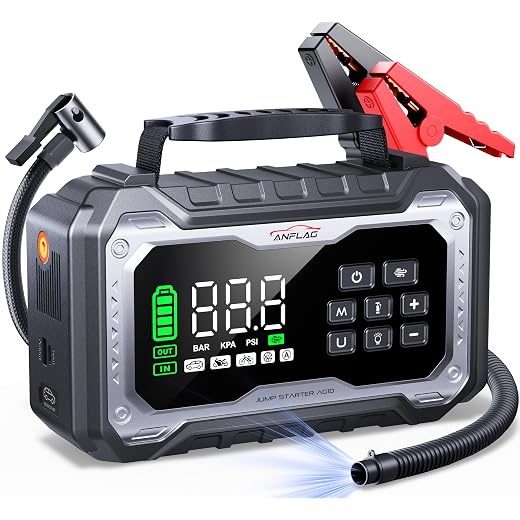
Positioned as the most versatile option in this lineup, the ANFLAG AG10 combines serious cranking capability with a useful tire station and a rare high-flow blower function. Verified owner sentiment highlights reliable starts on cars, SUVs and diesel vans, including vehicles left standing for extended periods, with only a small portion of charge used per start. The housing uses rugged fire-resistant plastics with a compact, carry-case-friendly footprint, while smart cables and 10-point protection add confidence for less experienced users. Day to day, the appeal is frequency of use: digital pressure selection with auto shut-off for tires, bikes and balls, plus blower nozzles for mattresses, kayaks and vacuum bags, alongside USB charging and an 800-lumen light with SOS modes. Trade-offs are bulk and weight compared with pocket boosters, and compressor cool-down pauses on multiple tires. For drivers wanting one boot box for dead batteries and flat tires, it earns its place.
- Strong starting performance for gas and large diesel engines noted across verified owner feedback
- True all-in-one versatility with compressor, blower, light and USB charging in one case
- Auto shut-off pressure control with multiple modes and adaptors for cars, bikes and balls
- Rugged organized kit with hard carry case keeps cables and hoses boot-ready
- Thoughtful safety system with reverse-polarity, short-circuit and temperature safeguards
- Heavier and bulkier than minimalist boosters, less pocket-friendly for daily carry
- Compressor needs cool-down pauses when inflating multiple flat tires back-to-back
- Relies on included USB cable for recharging with no wall adapter in the box
Buyer Questions and Expert Answers
What peak amps do I need for my car in the United Kingdom?
For most petrol cars, small SUVs and vans, 1250A provides confident starts in normal UK weather. Choose 2000A if you run a larger petrol, mid-to-large diesel, or often face cold starts and short trips. Reserve 3000A for large diesels up to 7.0L, commercial vans, 4x4s and agricultural vehicles where cranking demand is highest.
Will these jump starters work on a fully flat battery?
Yes, when equipped with UltraSafe protection and manual override functions. Connect correctly to the battery terminals, allow the safety system to detect voltage, and engage override only if the battery is too flat to be detected. The 2000A and 3000A models are particularly suited to deeply discharged batteries.
Are lithium jump starters safe for beginners to use?
Modern UltraSafe designs are built for beginners with spark-proof connections and reverse-polarity protection that prevent damage if clamps touch or are reversed. Always connect red to positive (+) and black to a solid earth point, keep the pack away from moving belts, and remove it promptly after the engine starts.
Can I use a jump starter as a power bank and torch?
Yes. All three winners offer USB charging for phones and devices, with the compact 1250A model adding versatile 60W USB-C output. The larger models add practical roadside extras like a voltmeter to check battery health and a bright multi-mode LED for night-time breakdowns.
How should I store and maintain a jump starter for maximum life?
Store it charged in the boot or garage, topped up every 3-6 months, as lithium packs self-discharge slowly. Avoid leaving it fully depleted or in extreme heat. Check indicators before long trips and winter, recharge after each jump-start use, and keep clamps clean and dry to preserve connection quality.
The Bottom Line
- 🏆 Top Overall Choice: NOCO Boost X GBX45: 1250A UltraSafe Jump Starter Power Pack – 12V Car Battery for compact readiness, strong everyday starting and USB-C versatility
- 💰 Best Value: NOCO Boost GB70: 2000A UltraSafe Jump Starter Power Pack – 12V Car Battery for powerful flat-battery starts and forgiving safety on large engines
- ⭐ Premium Pick: NOCO Boost GB150: 3000A UltraSafe Jump Starter Power Pack – 12V Car Battery for massive cranking capability on large petrol, diesel and commercial engines
For most UK drivers, balance wins: you want enough cranking power for cold mornings and diesels without carrying unnecessary weight. The compact 1250A all-rounder is the easiest to live with day to day, the 2000A model is the sweet spot for bigger engines and fully flat batteries, and the 3000A powerhouse is the confident choice for commercial and agricultural demands. Choose based on your largest engine, how often you face flat batteries, and whether you prioritise portability or maximum reserve.
Leave a Reply